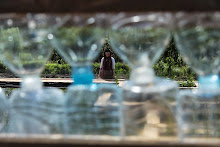
Last weekend I went to Belgium to attempt to build a
floating planter for my current project, Floating Delights. Below are some
pictures of the building process and the final floating planter. Special thanks to the bottle collectors and my family.
Wednesday, May 8, 2013
Monday, May 6, 2013
Floating Delights

This project came about in response to the competition brief for the 2013 Hortillonnages Art, Ville et Paysage Garden Festival in Amiens, France. Through this festival, the Maison de la Culture de Amiens aims to re-define the Hortillonnages. The Hortillonnages comprises a series of man-made islands situated within the flooding area of the Somme. These islands were originally created for the production of food, but due to the evolution of agriculture in the last century they have fallen into disrepair. Through the Art, Ville et Paysage project the MCA aims to engage young artists and designers to come up with new sustainable uses for these islands and assist in their conservation.
My submission, Floating Delights, responded to the brief on 3 levels. Firstly it aimed to protect the island against erosion by using a retaining wall of wood and plastic bottles in certain locations and native planting in others. The retaining wall of wood and plastic bottles consists of a wooden structure that retains the soil alongside plastic bottle cladding, which breaks the waves and protects the wooden structure. The native planting areas will reinforce the banks of the island with their roots and provide a habitat for the local wildlife.
Secondly, Active local community engagement is encouraged through the process of building the garden in order to help progress the conservation of the Hortillonnages: the key building material, plastic bottles, would be collected from the local community. It also facilitates the promotion of the Hortillonnage, as collection points would be dotted around Amiens.
Lastly, this project devises a new type of agriculture more attuned to its environment and makes use of waste as a building material. The garden would consist of a pond with floating planters within it: these planters would gain their buoyancy from the plastic bottles collected from the community. They will be planted with edible aquatic and marshland planting that draw their nutrients from the water, simultaneously providing food while also purify the water. The planters can be reeled in through a pulley system so the plants can be harvested.
The last few months have involved liaising with the Maison de la culture in Amiens, France to make this project a reality. This project will be on site from the 18th of May and will be completed by the 2nd of June. The garden festival runs from the 15th of June till the 13th of October.
http://www.artcitieslandscape.com/index.php
My submission, Floating Delights, responded to the brief on 3 levels. Firstly it aimed to protect the island against erosion by using a retaining wall of wood and plastic bottles in certain locations and native planting in others. The retaining wall of wood and plastic bottles consists of a wooden structure that retains the soil alongside plastic bottle cladding, which breaks the waves and protects the wooden structure. The native planting areas will reinforce the banks of the island with their roots and provide a habitat for the local wildlife.
Secondly, Active local community engagement is encouraged through the process of building the garden in order to help progress the conservation of the Hortillonnages: the key building material, plastic bottles, would be collected from the local community. It also facilitates the promotion of the Hortillonnage, as collection points would be dotted around Amiens.
Lastly, this project devises a new type of agriculture more attuned to its environment and makes use of waste as a building material. The garden would consist of a pond with floating planters within it: these planters would gain their buoyancy from the plastic bottles collected from the community. They will be planted with edible aquatic and marshland planting that draw their nutrients from the water, simultaneously providing food while also purify the water. The planters can be reeled in through a pulley system so the plants can be harvested.
The last few months have involved liaising with the Maison de la culture in Amiens, France to make this project a reality. This project will be on site from the 18th of May and will be completed by the 2nd of June. The garden festival runs from the 15th of June till the 13th of October.
http://www.artcitieslandscape.com/index.php
Tuesday, March 29, 2011
Chaumont-sur-Loire Garden Festival progress 1
After weeks of carefull planning, trying to speak French and in the end asking my dad to drive to France with an extra truck of materials, we are finally here in Chaumont.
We had our first day of work and most of the digging on site is done, thanks to the help of Herve. He looks a lot like professor Calcus from the adventures of Tintin. He is genius with the digger.
Also all the arrangements I've made so far worked out exactly as planned, maybe my french isn't so bad after all. So far so good!
Monday, February 21, 2011
Chaumont-sur-Loire Garden Festival

At the end of this summer I submited a design for the 2011 Chaumont-sur-Loire Garden Festival, France. And I was one of the lucky few who got selected to build my garden. Assisting me with the tedious task is Aquarium Architecture, Stan (ex-colleague from the Netherlands) and Michael (a very reliable friend). This project has caused me already a few years of my life and many grey hairs, but it seems we are set to go now. My garden is named Le Jardin de Marees/Garden of the Tides and is inspired by the seas, for more information on the project itself check out my website: http://www.sarahfoque.com/landscape/landscapeproj17.html
I will keep you posted on the progress, now off to order some material in French (not my speciality!).
Sunday, April 4, 2010
Art
Recently I have been re-reading or starting to read books I've read some time ago or have been intending to read for a while. It really gave a renewed perspective on my art-practice, a new focus, which I feel I had lost for a while. My work focuses on the ephemeral nature of the landscape and which role people play in this constantly changing landscape. I'm interested in how to represent this drifting landscape, how to grasp the ever-changing nature of environment, which we help to create. I want to understand and use it as a tool for my designs.Currently I am reading Rhythmanalysis: Space, time and Everyday Life, by Henri Lefebvre. He see our world as a collection of rhythms, each element has its own rhythms, which is constituted out of millions of rhythms themselve. The tree, which can be seen as a static element, suddenly becomes a living thing in motion. It moves but much slowerr than us. I just love these ideas. It makes you look at the world with completely new eyes.
I am starting to return to my thinking before I left Edinburgh, I don't know whether this is a good or a bad thing, but it definately gives me a renewed energy.
Wednesday, March 17, 2010
Markus Miessen Lecture
This evening I went to a Markus Miessen lecture at Stroom in The Hague. It was really interesting. Markus Miessen is the writer of did someone say participate and the violence of participation. During his lecture which was mostly based on the ideas of the last mentioned book, he showed us projects which he considered as failures. Believe me they weren't failures, each one of them was very inquisitive and very to the heart of things. It was very refreshing to see someone so succesful being really humble and constantly striving to learn and do better. An inspiration to us all I would say. He had such a good understanding of our world and how it works on societal and political level and how this relates to creation of space, but still had the naivity to believe in people. I think that this positive view towards humanity makes him create his projects. He really wants to make a difference, but he also has the patience to achieve it. All in all a very inspiring person!
Thursday, December 17, 2009
Screen printing
A month and a half ago I did an introduction course into screen printing. Ever since I go every Friday faithfully to the workshop to make some more prints. The medium is perfect to capture the mystifying city with all its layers. The different print layers allow me to represent an aspect of city life. I recently started working on a serie, which I call Carte postale, of which 2 will be shown at the ProofDruk exhibition at de Haagse Kunstkring. Carte postale refers to an old post card collection book, which I bought years ago on a flee market. It is falling a part, but its title still has a golden shimmer: Carte Postale.
My prints are a bit like post cards. They show the cities I know, not in photographic sense. They attempt to clarify the scene shown, how it flows and functions, how things relate to one another. Each printing layer shows an aspect of city life in certain location in an abstracted version: Architectural relationships through abstracted geometric shapes, the reality through a photograph and movements through tape or sticky vinyl.

My prints are a bit like post cards. They show the cities I know, not in photographic sense. They attempt to clarify the scene shown, how it flows and functions, how things relate to one another. Each printing layer shows an aspect of city life in certain location in an abstracted version: Architectural relationships through abstracted geometric shapes, the reality through a photograph and movements through tape or sticky vinyl.

Carte Postale 1
Subscribe to:
Comments (Atom)